
VEVOR Rectangle Solar Pool Covers — Sizes, Thickness & Fit Guide


If you own a rectangular above-ground pool, a VEVOR rectangle solar pool cover can help reduce heat loss, slow evaporation, and keep your pool warmer between swims.
The main decision is not just size. You also need to choose the right thickness. An 8mm cover is lighter and easier to handle, a 12mm cover is the best all-round choice for most pool owners, and a 16mm cover gives stronger heat retention but becomes heavier on larger pools.
This guide compares VEVOR rectangular solar cover sizes from 24 ft × 12 ft up to 40 ft × 20 ft, explains the difference between 8mm, 12mm, and 16mm covers, and helps you choose the right option for your pool, climate, and handling setup.
If you have a round pool instead, see our VEVOR round solar pool covers guide for round sizes and thickness options.
Quick verdict: which VEVOR rectangle solar cover should you choose?
For most rectangular above-ground pools, the best choice is a 12mm VEVOR solar cover. It gives a good balance of heat retention, price, durability, and day-to-day handling.
Choose 8mm if you want the lightest and cheapest option, especially for a very large pool where weight matters.
Choose 16mm if you want stronger insulation, better overnight heat retention, and longer seasonal use — but only if you have a reel or help removing the cover.
Best simple rule:
8mm = easiest to handle
12mm = best all-round choice
16mm = strongest heat retention
VEVOR Rectangle Solar Pool Cover Sizes:
VEVOR rectangle solar pool covers are available in several common above-ground pool sizes, including 24×12, 28×14, 32×16, 36×16, 36×18, and 40×20 options depending on the thickness you choose.
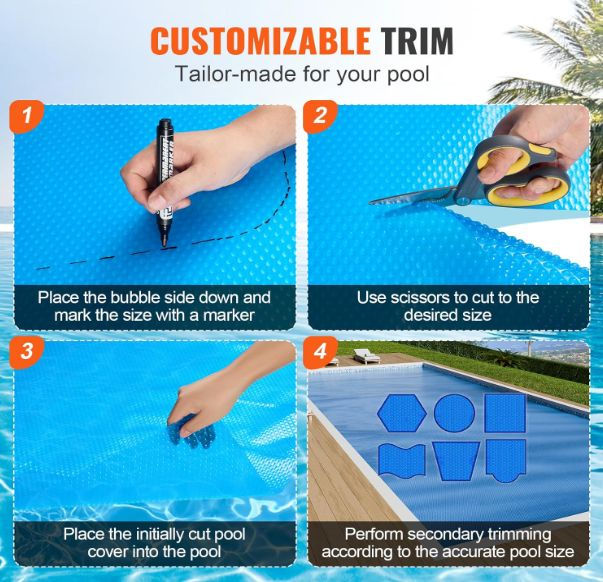
If your pool is slightly smaller than the cover size, you can trim the cover to fit. VEVOR’s product guidance shows the cover can be marked and cut with scissors, allowing you to shape it around the edges of your pool if needed.
For the best fit, choose the closest larger size rather than a smaller one. A slightly oversized solar cover gives you room to trim, while an undersized cover may leave too much exposed water and reduce heat retention.
For oval above-ground pools, a rectangle solar cover can also be a practical option. If you choose a cover that is large enough to cover the full length and width of your oval pool, you can trim the corners and edges so it fits neatly inside the oval shape. This can be useful when an exact oval solar cover size is harder to find, or when a rectangular VEVOR cover gives you better thickness or size options.
Just make sure the rectangle cover is larger than your pool’s widest points before cutting. Once trimmed, the cover should sit flat on the water surface without bunching heavily around the sides.
Available VEVOR Rectangle Solar Pool Cover Sizes
24 ft × 12 ft — 12mm — Good small-rectangular option for modest above-ground pools; balanced performance.
24 ft × 12 ft — 16mm — Thicker version for cooler nights or long season use.
28 ft × 14 ft — 12mm — Solid mid-size pick; reels handle it well.
28 ft × 14 ft — 16mm — Best if you want more insulation and longer life.
32 ft × 16 ft — 12mm — Larger pools: 12mm still reels OK and gives good retention.
32 ft × 16 ft — 16mm — Upgrade choice for extended seasons in cooler climates.
36 ft × 16 ft — 12mm — Large pool coverage; consider strong reel and two-person handling.
36 ft × 18 ft — 8mm — Budget option for very large pools; expect lighter insulation.
36 ft × 18 ft — 12mm — Better retention for big pools; a good compromise.
40 ft × 20 ft — 12mm — Very large pools — choose a robust reel and crew for handling.
40 ft × 20 ft — 16mm — Top insulation for huge pools; heavy, needs mechanical aid to reel.
Quick pick for busy readers: if you want a single rule — go with 12mm for most rectangular above-ground pools; choose 16mm for colder/windy sites or if you want the maximum season extension. Use 8mm only when budget and frequent manual handling are the priority.
Which thickness is best: 8mm, 12mm, or 16mm?
8mm — best for easy handling and lower cost
An 8mm rectangle solar cover is the lightest option. It is easier to pull on and off the pool, easier to store, and usually cheaper than thicker covers.
This makes sense if you have a very large rectangular pool, a mild climate, or you plan to remove the cover manually most days.
The trade-off is heat retention. An 8mm cover can still reduce evaporation and help hold some warmth, but it will not insulate as well as a 12mm or 16mm cover.
12mm — best for most rectangular above-ground pools
A 12mm VEVOR rectangle solar cover is the best all-round choice for most pool owners.
It gives stronger heat retention than 8mm while still being easier to handle than 16mm. If you are unsure which thickness to choose, this is usually the safest option.
Choose 12mm if you want a practical balance of warmth, price, weight, and daily usability.
16mm — best for stronger heat retention
A 16mm rectangle solar cover is the better choice if you want maximum insulation, longer seasonal use, or better overnight heat retention.
It makes the most sense in cooler, windier, or less sheltered yards.
The downside is weight. On larger rectangular pools, a 16mm cover can be awkward without a strong reel or a second person helping. Do not choose 16mm just because it sounds “best” if you will struggle to remove and store it.

How to measure your rectangular pool for the right cover
Measure the water surface, not the outside frame of the pool.
Use these steps:
Measure the inside length of the pool from water edge to water edge.
Measure the inside width of the pool from water edge to water edge.
Choose the closest standard cover size that matches or slightly exceeds those measurements.
Allow a small amount of overlap if needed, but avoid choosing a cover that is much larger than your pool.
If the cover is slightly oversized, trim carefully after checking the fit on the water.
For example, if your pool measures close to 27 ft × 13.5 ft across the water, a 28 ft × 14 ft cover will usually make more sense than sizing down.
Installation and handling tips for rectangular solar covers
Place the solar cover bubble side down on the water. The bubbles should face the pool water, while the smoother side faces upward.
For rectangular pools, line up the long edge of the cover with the long side of the pool. This helps prevent twisting, folding, and uneven overlap.
A reel is strongly recommended for larger rectangular covers, especially 12mm and 16mm options. Without a reel, the cover can become awkward to remove, more likely to crease, and easier to damage over time.
When the cover is not on the pool, keep it out of direct sun if possible. Leaving a dry solar cover folded in strong sunlight can shorten its lifespan.
Common fit problems with rectangular solar covers
The cover is slightly too large
A slightly oversized cover is usually manageable. Center it on the water and check whether the excess material interferes with rails, ladders, decks, or the reel.
As the manufacturer allows trimming, trim slowly and evenly. Do not cut aggressively on the first attempt.
The cover is too small
A cover that is too small will leave gaps around the edges. Those gaps allow more heat loss and evaporation, especially overnight or in windy weather.
If the cover sits well inside the pool edge, exchange it for the next suitable size rather than trying to stretch it.
The cover lifts in the wind
Large rectangular covers can catch wind more easily than smaller round covers. If your yard is exposed, remove the solar cover during strong wind or secure it properly with a suitable pool cover system.
Do not rely on the solar cover alone as a winter cover or safety cover. It is designed for heat retention and evaporation control, not for heavy-duty storm protection.
Pros & cons of VEVOR rectangular solar covers
Pros
Good range of rectangular sizes for larger above-ground pools.
Multiple thickness options, including 8mm, 12mm, and 16mm.
12mm gives a strong balance of heat retention and usability.
Can help reduce evaporation and overnight heat loss.
Useful pairing with a pool heat pump, gas heater, or solar heating setup.
Cons
Large rectangle covers can be heavy without a reel.
16mm options may be awkward for one person to handle.
8mm covers are easier to manage but offer less insulation.
Some listings combine several sizes and thicknesses, so you need to check the exact option before buying.
Not a replacement for a safety cover or winter cover.
Who should buy a VEVOR rectangle solar pool cover?
Choose a VEVOR rectangle solar pool cover if you want a simple way to hold more heat in your pool, reduce evaporation, and make your heater or heat pump work less hard.
It is a good fit if you have a rectangular above-ground pool and want a cover that is available in common larger sizes.
A 12mm cover is the best fit for most pool owners. Choose 16mm if heat retention matters more than easy handling. Choose 8mm if you want the lowest weight and easiest daily removal.
Who should skip it?
Skip a heavy 16mm cover if you do not have a reel and plan to remove it by yourself every day.
You should also skip this style of cover if you need a safety cover, winter cover, or something designed to hold weight. A solar cover is for heat retention and evaporation control — not safety.
If your pool is round, use the VEVOR round solar pool covers guide instead of forcing a rectangular cover to fit.
FAQ
What thickness VEVOR rectangle solar cover is best?
For most rectangular above-ground pools, 12mm is the best thickness. It gives better heat retention than 8mm while still being easier to handle than 16mm. Choose 16mm if you want stronger insulation and have a reel. Choose 8mm if you want the lightest and cheapest option.
Should I choose 8mm, 12mm, or 16mm for a rectangular pool?
Choose 8mm for easier handling and lower cost, 12mm for the best all-round balance, and 16mm for stronger heat retention. Larger rectangular pools become harder to manage as the cover gets thicker, so weight matters as much as insulation.
What size solar cover do I need for a rectangular above-ground pool?
Measure the inside length and width of the pool across the water surface. Choose the closest standard cover size that matches or slightly exceeds those measurements. A small amount of overlap is fine, but too much extra material can be awkward to reel, trim, or secure.
Do bubbles go up or down on a solar pool cover?
The bubbles should face down into the water. This helps the cover sit properly on the pool surface and improves heat retention. The smoother side should face upward.
Is a reel necessary for a rectangular solar pool cover?
A reel is strongly recommended for larger rectangular solar covers, especially 12mm and 16mm versions. It makes the cover easier to remove, helps prevent creasing, and can extend the life of the cover.
Can I use a rectangle solar cover on a round pool?
A rectangular solar cover is not the best choice for a round pool. It can leave awkward overlap and be harder to secure neatly. If you have a round pool, use a round solar cover instead.
Can a solar cover replace a winter cover or safety cover?
No. A solar cover is designed to reduce evaporation and heat loss. It is not a safety cover, winter cover, or heavy-duty storm cover.
Final recommendation
A VEVOR rectangle solar pool cover is a practical upgrade if your main goal is to keep more warmth in the pool and reduce daily heat loss.
For most rectangular above-ground pools, the 12mm version is the best starting point because it balances insulation, price, and handling. The 16mm version is better for cooler weather and longer season use, but it becomes heavier on larger pools. The 8mm version is best when budget and easy handling matter more than maximum heat retention.
The smartest setup is to pair the solar cover with the right heating system and a reel. That gives you better temperature control, easier daily use, and less wasted heat overnight.
For more heating options, see our Heat Pumps & Solar Covers guide and our Warm Up Your Pool guide.
Read next — related articles:
Explore the Heat Pumps & Solar Covers — comparisons, buying guides, and pairing strategies for the best cost-effective pool heating.
Warm Up Your Pool (Eco-Friendly & Cheap Solutions) — our practical guide to eco-friendly and low-cost heating solutions.


Comments