
Pool Shock 101: How to Shock an Above-Ground Pool

Pool shock is a high-dose pool treatment used to kill algae, break down contaminants, clear cloudy water, and restore safe chlorine levels. For above-ground pools, shocking is most useful after heavy swimming, rain, algae growth, cloudy water, low chlorine, or strong chlorine smells.
The fastest way to shock an above-ground pool is to test the water, balance the pH, add the correct shock dose in the evening, run the pump continuously, brush the pool, and retest before swimming.
Most above-ground pools should only need shock as needed, not every day. If your pool stays cloudy, green, or smelly after shocking, the real problem may be poor filtration, low stabilizer, high pH, or not enough circulation.
Quick verdict: when should you shock your pool?
Shock your above-ground pool when chlorine is too low, the water turns cloudy, algae starts growing, the pool smells strongly of chlorine, or the pool has been used heavily.
For routine maintenance, shock is usually helpful after heavy swimming, heavy rain, hot weather, or visible water problems. For green water, shock is only one part of the fix — you also need brushing, filtration, vacuuming, and balanced water chemistry.
Best for: Cloudy water, algae, low chlorine, heavy use, and organic debris buildup.
Not enough on its own for: Poor filtration, high pH, low stabilizer, clogged filters, or severe algae problems.
Before swimming again: Always test the water and wait until chlorine levels return to the safe range listed on your product instructions.
For more help choosing chlorine, test strips, clarifiers, and algae treatments, see our guide to chemicals and water care products for above-ground pools.
What is pool shock?
Pool shock is a concentrated pool treatment used to raise sanitizer levels quickly. It helps kill algae, bacteria, and organic contaminants that normal chlorine levels may not control.
For above-ground pools, shock is most useful when the water turns cloudy, algae appears, chlorine drops too low, the pool smells strongly of chlorine, or the pool has been used heavily.
Shock works best when the water is tested first, the pH is balanced, the pump is running, and the pool is brushed so algae and debris are not stuck to the liner.

Types of pool shock: which one should you use?
Different pool shock types work better for different problems. The best option depends on whether you are treating algae, cloudy water, routine chlorine loss, or sensitive water conditions.
For most above-ground pool owners, chlorine shock is the stronger choice when the water is green, cloudy, or low in sanitizer. Non-chlorine shock is better for routine oxidation when you are not fighting visible algae.
What you need before shocking an above-ground pool
Before adding pool shock, make sure you have the basics ready. Shock works best when the water is tested, the pH is in range, and the pump can circulate the treatment properly.
You may need:
Pool test strips or a liquid test kit — to check chlorine, pH, alkalinity, and stabilizer before dosing.
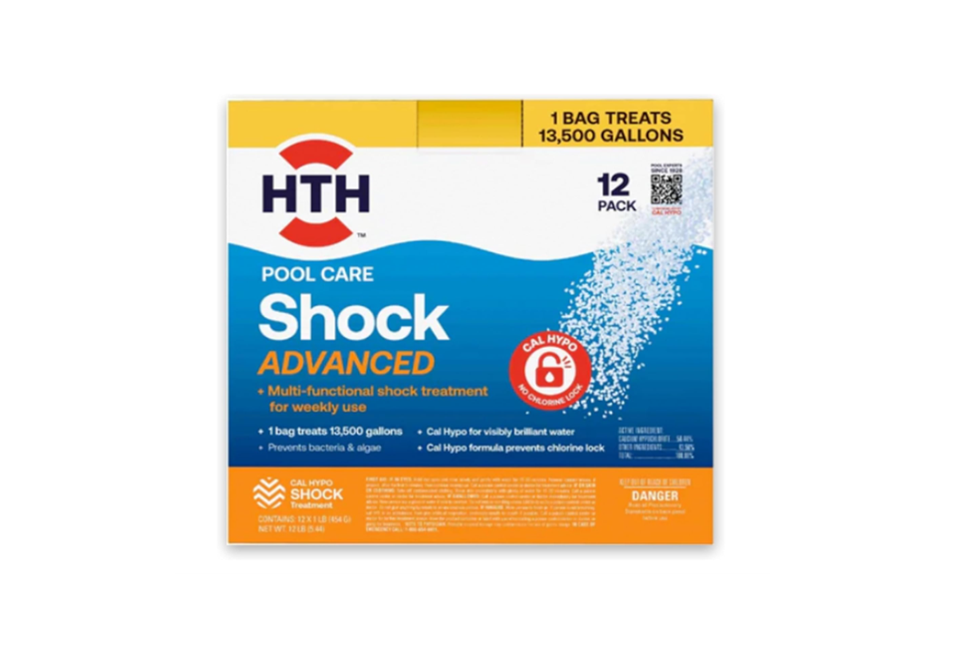
Pool shock or liquid chlorine — to raise sanitizer levels and kill algae or contaminants.
A pool brush — to loosen algae, dirt, and buildup from the liner, ladder, corners, seams, and floor.
A working pump and filter — to circulate the shock and remove dead algae or suspended debris.
A skimmer net — to remove leaves, bugs, grass, and floating debris before shocking.
A handheld pool vacuum — useful after shocking if dead algae or fine debris settles on the pool floor.
Pool clarifier — helpful if the water turns cloudy after the algae is dead and the filter needs help catching fine particles.
Do not treat shock like magic powder. If the pool is dirty, the filter is clogged, or the water chemistry is badly off, shock alone will not fix the problem.
How to shock an above-ground pool
Shocking an above-ground pool works best when you follow the right order. Do not just throw shock into the water and hope for the best. Test first, balance the water, add the correct dose, circulate it properly, and retest before swimming.
Step 1: Test the water first
Before adding pool shock, test your water for free chlorine, pH, total alkalinity, and stabilizer/cyanuric acid.
This matters because shock will not work as well if the water is badly out of balance. If the pH is too high, chlorine becomes less effective. If stabilizer is too high or too low, chlorine may either burn off too quickly or struggle to work properly.
At minimum, check:
Free chlorine
pH
Total alkalinity
Cyanuric acid/stabilizer
Water clarity
If the pool is green, cloudy, or has a strong chlorine smell, testing first helps you understand whether you are dealing with low sanitizer, algae, poor filtration, or unbalanced water.

Step 2: Balance the pH
Before shocking, aim to bring the pH into the correct range listed on your pool shock product or test kit. In most cases, pool shock works best when the pH is properly balanced before treatment.
If the pH is too high, the chlorine in your shock may be less effective. If the pH is too low, the water can become uncomfortable and potentially harsh on pool surfaces and equipment.
Do not skip this step. A lot of pool owners waste shock because they add it to badly balanced water and then wonder why the pool still looks cloudy or green the next day.
Step 3: Calculate the correct shock dose
Use your pool size in gallons and follow the dosage instructions on the shock product you are using. Different shock products have different strengths, so do not guess based only on bag size.
A small above-ground pool needs far less shock than a large rectangular or oval pool. Overdosing can waste money and delay swimming, while underdosing may not kill algae or clear the water properly.
Use your pool’s gallon size before dosing. If you are not sure, use our pool volume calculator to estimate how much water your above-ground pool holds.
For green or algae-heavy water, you may need a stronger treatment than you would use for routine maintenance. Always follow the product label and retest the water before swimming.
Step 4: Add shock in the evening
The best time to shock an above-ground pool is in the evening or at night. Sunlight breaks down chlorine, so adding shock during the day can make the treatment less effective.
Before adding shock, make sure the pump is running. Add the product according to the label instructions. Some shock products can be added directly to the pool, while others may need to be dissolved first in a bucket of water.
Never mix different chemicals together, and never add water to chemicals. If pre-dissolving is required, follow the product instructions carefully.
After adding shock, keep people and pets out of the pool until the chlorine level returns to the safe range.
Step 5: Run the pump and brush the pool
After shocking, run the pump continuously so the treatment circulates through the entire pool. This helps distribute the shock and allows the filter to remove dead algae, dirt, and fine particles.
If your pool keeps turning cloudy or green after shocking, filtration may be part of the problem. Our Filtration & Pumps guide can help you check whether your pump, filter, or circulation setup is holding the water back.
Brush the pool walls, floor, ladder, steps, corners, and seams. Brushing is especially important if the pool is green or if algae is stuck to the liner. Shock works much better when algae is loosened from the surfaces instead of sitting in patches.
If the water turns cloudy after shocking, that is common. It often means dead algae and fine debris are suspended in the water. Keep filtering, clean or backwash the filter when needed, and give the pool time to clear.
Step 6: Retest before swimming
Do not swim immediately after shocking. Test the water first and wait until chlorine returns to the safe range listed on your product instructions or test kit.
The waiting time depends on the type of shock used, the dose, pool size, sunlight, water temperature, and circulation. For many pools, this can mean waiting several hours or overnight.
Before swimming again, check that:
Chlorine is back in the safe range
pH is balanced
The water is clear enough to see the pool floor
The pump and filter are working properly
If the chlorine is still too high, wait longer and retest. If the water is still cloudy, keep filtering and check whether the filter needs cleaning.
When should you shock your pool?
You should shock your above-ground pool when normal chlorine levels are not enough to keep the water clean, clear, and safe.
The most common times to shock a pool are:
After heavy swimming
After heavy rain or storms
When chlorine is low
When the water looks cloudy
When algae starts to appear
When the pool smells strongly of chlorine
After leaves, grass, bugs, or debris enter the water
After opening the pool for the season
Before closing the pool for winter
A strong chlorine smell does not always mean there is too much chlorine. It can mean the chlorine is being used up fighting contaminants. In that case, shocking can help break down the combined chlorine causing the smell.
For normal maintenance, do not shock blindly every day. Test the water first and treat based on what the pool actually needs.
If your pool keeps needing shock again and again, the problem is probably not shock. It may be poor circulation, weak filtration, low stabilizer, high pH, heavy debris, or not enough regular chlorine.
If the water has already turned green, follow our full guide on how to clear a green above-ground pool before relying on shock alone.
Common pool shock mistakes to avoid
Pool shock works, but only when it is used properly. These are the mistakes that waste money and leave above-ground pool owners frustrated.
Adding shock without testing first
Guessing is a bad strategy. If you do not test the water, you do not know whether the issue is low chlorine, high pH, poor stabilizer levels, or weak filtration.
Test first, then treat.
Shocking when the pH is too high
High pH can make chlorine less effective. If your pH is badly out of range, shock may not perform as well as expected.
Balance the pH before shocking whenever possible.
Not using enough shock for green water
A lightly cloudy pool and a green algae-filled pool are not the same problem. Green water usually needs a stronger treatment, more brushing, more filtration, and sometimes repeated testing.
Using too little shock may only weaken the algae instead of clearing the pool.
Turning the pump off too soon
After shocking, the filter needs time to remove dead algae and fine debris. Turning the pump off too soon slows the cleanup and can leave the pool cloudy.
For green or cloudy water, keep the pump running continuously if possible.
Skipping brushing
Shock cannot do its best work if algae is stuck to the liner, ladder, walls, or seams. Brushing exposes the algae and helps the shock reach it.
This is one of the simplest steps, but it is also one of the most commonly skipped.
Swimming too soon
Do not swim until the chlorine level has returned to the safe range. High chlorine can irritate skin, eyes, and swimwear.
Always test before getting back in.
Using shock as a replacement for regular maintenance
Shock is not a substitute for normal chlorine, filtration, brushing, skimming, and water testing. It is a treatment, not a full maintenance plan.
If your pool only looks good for a day or two after shocking, something else in your routine needs fixing.
Can you swim after shocking a pool?
You should not swim immediately after shocking a pool. Wait until the chlorine level returns to the safe range listed on your shock product, test kit, or pool-care instructions.
For many above-ground pools, this may take several hours or overnight. The exact time depends on the shock type, dose, pool size, water temperature, sunlight, and pump circulation.
Before swimming again, make sure:
The chlorine level is safe
The pH is balanced
The water is clear
The pool floor is visible
The shock product has fully circulated
If the water is still cloudy or the chlorine is still high, wait longer and retest.
A simple rule: if you have not tested the water after shocking, do not swim yet.
If the algae is dead but the water still looks dull or milky, follow our guide to clear cloudy pool water without over-treating the pool.
Pool shock vs algaecide vs clarifier
Pool shock, algaecide, and clarifier are not the same thing. They solve different problems, and using the wrong one can waste money.
Pool shock raises sanitizer levels and helps kill algae, bacteria, and organic contaminants. It is usually the first product to use when chlorine is low, the water is cloudy, or algae starts growing.
Algaecide is better used as a support product or preventative treatment. It can help with stubborn algae, but it should not replace proper chlorine levels, brushing, filtration, and shock treatment.
Pool clarifier helps tiny particles clump together so the filter can catch them. It is useful when the water is cloudy after algae is dead, but it will not kill algae by itself.
For a green above-ground pool, start with testing, brushing, shock, and filtration. For cloudy water after treatment, a clarifier may help. For algae that keeps returning, check chlorine, stabilizer, pH, circulation, and filter performance before adding more products.
Helpful guides before you add more chemicals
If you are still deciding what your pool needs, these guides can help you avoid over-treating the water:
👉 Chemicals & Water Care — compare chlorine, shock, algaecide, clarifier, test strips, and other water-care products for above-ground pools.
👉 How to Clear a Green Above-Ground Pool — follow the full cleanup process if your pool has already turned green from algae.
👉 How to Clear Cloudy Pool Water — use this guide if the algae is dead but the water still looks dull, milky, or hazy.
👉 Liquid Chlorine vs Chlorine Tabs — compare two common sanitizer options and see when each one makes sense.
👉 Pool Volume Calculator & Chlorine Dosage Guide — estimate your pool volume before adding shock, chlorine, or other chemicals.
For most above-ground pool owners, shock is only one part of the water-care routine. The real win is knowing when to use shock, when to filter longer, when to brush, and when another product is actually the better fix.
Final takeaway
Pool shock is useful, but it is not a shortcut for poor maintenance. It works best when the water is tested first, the pH is balanced, the pump is running, and the pool is brushed so algae and debris are exposed to the treatment. If your pool keeps needing shock every few days, look beyond the chemical dose and check filtration, circulation, stabilizer, debris load, and your regular chlorine routine.
Frequently asked questions about pool shock
What is pool shock?
Pool shock is a high-dose pool treatment used to raise sanitizer levels, kill algae, break down contaminants, and restore water clarity. It is commonly used when chlorine is low, the water is cloudy, algae appears, or the pool has been used heavily.
How often should I shock my above-ground pool?
Most above-ground pools should be shocked as needed, not automatically every day. Many pool owners shock after heavy swimming, heavy rain, hot weather, algae growth, cloudy water, or low chlorine readings. Always test the water first so you do not over-treat the pool.
When is the best time to shock a pool?
The best time to shock a pool is in the evening or at night. Sunlight can burn off chlorine quickly, so shocking later in the day gives the treatment more time to work.
Can I swim right after shocking my pool?
No. You should wait until the chlorine level returns to the safe range listed on your shock product or test kit. This often takes several hours or overnight, but the exact time depends on the product used, dose, pool size, and circulation.
Should I run the pump after adding pool shock?
Yes. Run the pump and filter after adding pool shock so the treatment circulates through the pool. For cloudy or green water, running the pump continuously can help remove dead algae and suspended particles.
Do I need to brush the pool when shocking?
Yes, brushing helps loosen algae and dirt from the liner, floor, ladder, seams, and corners. Shock works better when algae is not stuck tightly to pool surfaces.
Why is my pool still cloudy after shocking?
A pool can stay cloudy after shocking because dead algae, fine debris, poor filtration, high pH, or unbalanced water is still present. Keep filtering, clean or backwash the filter, brush the pool, and retest the water before adding more chemicals.
Is pool shock the same as algaecide?
No. Pool shock raises sanitizer levels and helps kill algae and contaminants. Algaecide is usually a support or prevention product. If your pool is already green, shock, brushing, filtration, and vacuuming are usually more important than algaecide alone.


Comments