
EASYTEST 7-Way Pool Test Strips Review for Above-Ground Pools
- AboveGroundSplash

- Jun 1
- 10 min read
Updated: Jun 2

EASYTEST 7-Way Pool Test Strips are a simple way to check the main water chemistry levels in an above-ground pool without using a liquid test kit. Each strip tests seven key areas: free chlorine, total chlorine, bromine, pH, total alkalinity, total hardness, and cyanuric acid.
For most above-ground pool owners, these strips make the most sense as a quick routine testing tool. They are useful for checking whether your water is safe, balanced, and ready for swimming, especially during hot weather, heavy pool use, after rain, or before adding chlorine, shock, algaecide, or other pool chemicals.
They are not a perfect replacement for a high-quality liquid test kit, but they are much easier to use for regular checks. If you want a fast, beginner-friendly way to monitor pool water before problems like cloudy water or algae get worse, EASYTEST 7-Way strips are a practical option.
Quick verdict
EASYTEST 7-Way Pool Test Strips are best for above-ground pool owners who want fast, regular water testing without complicated drops or reagents. They are especially useful for checking chlorine, pH, alkalinity, stabilizer, and hardness before deciding whether your pool needs chlorine, shock, clarifier, algaecide, or more filtration time.
The biggest advantage is convenience. You get 150 strips in one bottle, so it is easier to test consistently through the swimming season.
The main limitation is precision. Like most pool test strips, the results depend on good lighting, proper timing, and careful color matching. If your pool has a serious algae bloom, recurring cloudy water, or confusing chemical readings, use these strips as a quick guide and confirm important results with a liquid test kit when needed.
Best for: quick routine testing, beginner pool owners, weekly maintenance, and checking water before adding chemicals.
Skip it if: you need lab-level accuracy, exact CYA readings, or detailed troubleshooting for a badly neglected pool.
EASYTEST 7-Way Pool Test Strips specs
Feature | Details |
Product type | Pool and spa water test strips |
Strip count | 150 strips |
Tests included | Free chlorine, total chlorine, bromine, pH, total alkalinity, total hardness, cyanuric acid |
Best for | Routine above-ground pool water testing |
Pool types | Above-ground pools, hot tubs, spas, and chlorine or bromine systems |
Dip-and-compare color chart | |
Best use case | Fast weekly checks and basic water balance monitoring |
Main limitation | Less precise than a liquid test kit for exact troubleshooting |
EASYTEST 7-Way strips are best used for quick routine pool testing. They help you check chlorine, pH, alkalinity, hardness, and stabilizer levels before small water-balance problems turn into cloudy water, algae, or wasted chemicals.
What EASYTEST 7-Way Pool Test Strips measure
The biggest reason to use a 7-way strip is that it checks more than just chlorine. Chlorine matters, but pool water can still cause problems if pH, alkalinity, hardness, or stabilizer are out of range.
Free chlorine
Free chlorine is the active sanitizer in your pool. This is the chlorine available to kill bacteria, control algae, and keep the water safe.
If free chlorine is too low, your pool can turn cloudy or green quickly, especially in warm weather or after heavy swimming.
For dosing help, use our pool volume and chlorine dosage calculator to estimate how much chlorine your pool needs based on gallons, current free chlorine, and target free chlorine level.
Total chlorine
Total chlorine includes both free chlorine and combined chlorine. If total chlorine is much higher than free chlorine, your pool may have chloramines.
That can lead to chlorine smell, eye irritation, and water that does not feel as clean as it should.
pH
pH affects comfort and chlorine performance. If pH is too high, chlorine becomes less effective. If pH is too low, the water can become irritating and more corrosive.
For many above-ground pools, pH is one of the first things to check before adding shock, chlorine, algaecide, or clarifier.
Total alkalinity
Total alkalinity helps stabilize pH. If alkalinity is too low, pH can swing up and down. If it is too high, pH may be harder to adjust.
Testing alkalinity helps you avoid chasing pH problems without understanding the cause.
Total hardness
Total hardness measures calcium hardness. In above-ground pools, this matters because very low hardness can make water more aggressive, while high hardness can contribute to scaling or cloudy water.
Cyanuric acid / stabilizer
Cyanuric acid, often called stabilizer or CYA, helps protect chlorine from sunlight. But too much stabilizer can make chlorine less effective.
This is especially important if you regularly use stabilized chlorine tablets.
Bromine
Bromine is more common in spas and hot tubs, but some users still want strips that can check bromine levels. Having bromine included makes the strips more flexible if you use them across different water systems.

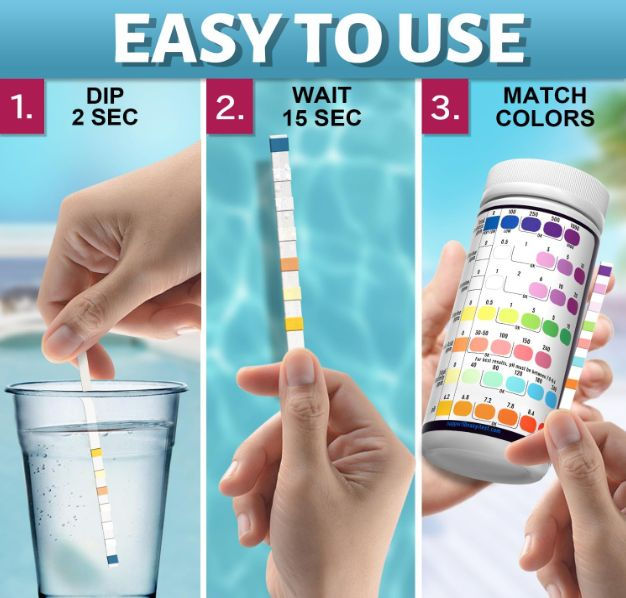
How to use EASYTEST 7-Way Pool Test Strips
Always follow the directions on the bottle first. Pool test strips can give misleading results if they are dipped too long, read too late, touched with wet fingers, or compared in poor lighting.
Step 1: Take a water sample away from returns
Test water from an area away from return jets, skimmers, or freshly added chemicals. This gives you a better reading of the overall pool water.
Step 2: Dip the strip
Dip one test strip into the pool water for the time stated on the product label. Do not leave the strip in the water longer than instructed.
Step 3: Hold the strip level
Remove the strip and hold it level. Do not shake off the water unless the product instructions specifically tell you to.
Step 4: Wait the correct amount of time
Wait the recommended time before reading the strip. Reading too early or too late can change the result.
Step 5: Compare with the color chart
Match each test pad to the color chart on the bottle. Use natural daylight if possible, because indoor lighting can make colors harder to judge.
Step 6: Act on the results
Do not add chemicals blindly. Use the strip results to decide whether you need chlorine, pH adjustment, alkalinity adjustment, shock, clarifier, or more filtration time.
When should you test your above-ground pool water?
You should test your above-ground pool regularly during swimming season, not just when the water looks bad.
Test more often when:
The weather is very hot.
The pool has had heavy use.
It has rained heavily.
You have just opened the pool.
The water looks cloudy.
The pool smells strongly of chlorine.
You have added shock, algaecide, clarifier, or other chemicals.
You use chlorine tablets and want to watch stabilizer levels.
For most pool owners, testing two or three times per week during peak season is a sensible routine. If your pool is heavily used, test more often. Regular testing also helps you catch problems before they turn into bigger issues, such as cloudy pool water or a green above-ground pool.
What EASYTEST 7-Way strips do well
EASYTEST strips are not trying to be a professional lab test. Their real value is helping normal pool owners test often enough to prevent avoidable problems.
They make regular testing easier
The easier testing is, the more likely you are to do it. That matters because most pool problems start small.
Low chlorine, high pH, rising stabilizer, or poor alkalinity can be caught early if you test regularly.
They check more than chlorine
A basic chlorine-only test is not enough for proper pool care. EASYTEST 7-Way strips give you a broader picture of your pool chemistry, including pH, alkalinity, hardness, and stabilizer.
That makes them more useful for above-ground pools where small water volumes can change quickly.
The 150-strip bottle is useful for the full season
A larger bottle means you are less likely to “save” strips and under-test your water. That is important because regular testing is one of the cheapest ways to avoid cloudy water, algae, and wasted chemicals.
They are beginner-friendly
You do not need to measure drops, count reagents, or run a complicated test. Dip the strip, wait, compare, and act.
That makes EASYTEST a good choice for new above-ground pool owners who are still learning water care basics.
Where EASYTEST strips are limited
This is where the page needs to be honest. Test strips are convenient, but they are not perfect.
Color matching can be subjective
Different lighting can make the colors look different. If you are testing indoors, in shade, or at sunset, your reading may be less reliable.
For best results, compare the strip to the bottle chart in bright natural light.
They are better for routine checks than exact diagnosis
If your pool is badly green, extremely cloudy, or constantly out of balance, strips can point you in the right direction. But they may not be precise enough for difficult troubleshooting.
In those cases, a liquid test kit can give more reliable detail.
CYA readings can be hard to judge
Cyanuric acid is one of the most important readings for chlorine pools, but strip-based CYA readings can be less precise than dedicated liquid tests.
If your chlorine seems weak even though the strip says you have enough stabilizer, your CYA level may be part of the problem. This is especially important if you use stabilized tablets, because they can slowly raise stabilizer over time. For more help deciding when tablets make sense and when liquid chlorine is the better choice, read our guide to liquid chlorine vs chlorine tablets.
EASYTEST strips vs liquid test kits
EASYTEST strips are best for fast, routine water checks. Liquid test kits are better when you need more precise readings.
Use EASYTEST strips when you want to:
Check water quickly before swimming.
Monitor chlorine, pH, alkalinity, hardness, and stabilizer.
Test several times per week without hassle.
Catch problems early.
Keep pool care simple.
Use a liquid test kit when you need to:
Troubleshoot a stubborn green pool.
Confirm confusing readings.
Measure stabilizer more accurately.
Dial in chlorine dosing more precisely.
Solve recurring cloudy water or algae problems.
For most above-ground pool owners, the best setup is not strips or liquid kits forever. It is strips for routine checks and a liquid kit when the water is not behaving normally.
Who should buy EASYTEST 7-Way Pool Test Strips?
Choose EASYTEST 7-Way strips if you want a simple, affordable way to monitor your pool water through the swimming season.
They make the most sense if:
You own an above-ground pool.
You want quick routine water checks.
You use chlorine tablets, liquid chlorine, shock, or algaecide.
You want to catch cloudy water or algae problems early.
You prefer simple color-strip testing over liquid reagents.
You want enough strips to test regularly without running out quickly.
EASYTEST is especially useful if you are still learning pool care and want a fast way to understand what your water needs before adding chemicals.
Who should skip EASYTEST 7-Way strips?
Skip EASYTEST as your only testing method if you need very precise readings or you are trying to solve a serious water problem.
You may want a liquid test kit instead if:
Your pool keeps turning green.
Your pool stays cloudy after shocking.
Your chlorine disappears quickly.
Your stabilizer level may be too high.
You need more accurate chemical dosing.
You are managing a large or heavily used pool.
Test strips are helpful, but guessing from unclear readings can lead to wasted chemicals. If the strip result does not make sense, confirm it before adding more products.
What to do after testing
Testing is only useful if you act on the result correctly. Here is how to think about common readings.
If chlorine is low, calculate the right chlorine dose instead of guessing.
If the water is cloudy, do not keep adding products blindly. Start by checking the filter, chlorine, pH, and circulation. If the problem continues, follow our guide on how to fix cloudy pool water before adding more chemicals.
If the pool is green, treat the algae properly before relying on prevention products. Our step-by-step guide on how to clear a green above-ground pool explains the right order: test, balance, brush, shock, filter, and vacuum.
If you use chlorine tablets, monitor stabilizer because CYA can build up over time and make chlorine less effective.
If algae keeps returning after the pool is already clean and balanced, a prevention product like PoolRx may help reduce recurring algae problems during peak season.
Helpful water-care guides
If you are building a simple above-ground pool water-care setup, these guides can help:
👉 Chemicals & Water Care — browse water testing, chlorine, shock, algaecide, clarifier, and pool maintenance products for above-ground pools.
👉 Pool Volume and Chlorine Dosage Calculator — calculate pool gallons, chlorine dose, and shock amount before adding chemicals.
👉 Liquid Chlorine vs Chlorine Tablets — compare fast chlorine correction with slow-release weekly maintenance.
👉 How to Clear Cloudy Pool Water — troubleshoot cloudy water without wasting chemicals.
Final verdict: are EASYTEST 7-Way Pool Test Strips worth it?
EASYTEST 7-Way Pool Test Strips are worth considering if you want a quick, low-effort way to monitor above-ground pool water. They test the key chemistry levels most pool owners need to watch, and the 150-strip bottle makes regular testing easier through the swimming season.
They are not the most precise option for serious troubleshooting, but they are a strong routine testing tool. For everyday above-ground pool care, they can help you catch low chlorine, pH problems, alkalinity issues, hardness concerns, and stabilizer buildup before they turn into bigger problems.
If you mainly want a simple way to test often and avoid guessing before adding chemicals, this 150-strip bottle is a practical season-long option.
Frequently asked questions
Are EASYTEST 7-Way Pool Test Strips good for above-ground pools?
Yes. EASYTEST 7-Way Pool Test Strips are a good fit for above-ground pools because they check the main water chemistry levels most pool owners need to monitor, including chlorine, pH, alkalinity, hardness, and cyanuric acid.
What do EASYTEST 7-Way Pool Test Strips test for?
EASYTEST 7-Way strips test free chlorine, total chlorine, bromine, pH, total alkalinity, total hardness, and cyanuric acid. These readings help you understand whether your pool water is sanitized, balanced, and safe to swim in.
How often should I test my above-ground pool water?
During swimming season, many above-ground pool owners should test at least two or three times per week. Test more often after heavy rain, hot weather, heavy swimming, chemical additions, or if the water starts to look cloudy or green.
Are pool test strips accurate enough?
Pool test strips are accurate enough for quick routine checks when used correctly, but they are not always as precise as liquid test kits. For serious algae problems, cloudy water, high stabilizer concerns, or confusing readings, confirm important results with a liquid test kit.
Can EASYTEST strips help prevent cloudy or green pool water?
Yes, they can help you catch low chlorine, high pH, poor alkalinity, or stabilizer problems before the water turns cloudy or green. However, test strips do not fix the problem by themselves. You still need to adjust the water based on the results.
Should I use test strips before adding pool shock?
Yes. You should test your water before adding shock so you know your chlorine, pH, alkalinity, and stabilizer levels. Shocking without testing can waste chemicals or fail to solve the real problem.


Comments