
Hayward XStream Cartridge Filter Review: Is It Worth the Price?

Updated: Sep 11

If you've reached the point where a small cartridge pump no longer feels like enough for your above-ground pool, the Hayward XStream is a very different proposition.
This review covers the current W3CC15093S system, which pairs Hayward's 150 sq ft XStream cartridge filter with a 1.5 HP PowerFlo Matrix pump. Hayward's current product records identify that exact combination.
This isn't really a direct alternative to an Intex C1000 or C1500.
It's a much larger, more expensive cartridge-filtration system aimed at owners who want serious filtration capacity without switching to sand.
And that distinction matters.
If you have a 12 or 15 ft pool, we'd struggle to justify spending this much on filtration.
But if you're running a larger above-ground pool and want to stay with cartridges, the XStream starts to make much more sense.
Quick Verdict
The Hayward XStream is the cartridge-filter system we'd start looking at when the smaller Intex-style cartridge pumps no longer give us enough filtration headroom.
The current W3CC15093S combines a 150 sq ft cartridge filter with a 1.5 HP PowerFlo Matrix pump, 1.5-inch plumbing and a proper pressure gauge. Hayward also uses an Easy-Lok ring that gives you access to the large internal cartridge without dealing with a multiport valve or backwashing.
For us, its sweet spot is larger above-ground pools, particularly once you're moving beyond the sort of 18 ft pool we'd comfortably pair with the Intex C2500.
For something around 21–27 ft round, or a similarly high-volume above-ground pool, this is the sort of cartridge system we'd start seriously considering — provided the pool's plumbing and fittings suit the 1.5 HP pump and 1.5-inch connections.
That's not a hard maximum or minimum. Actual gallons and the pool's plumbing still matter.
Best for: Larger above-ground pools where you want high-capacity cartridge filtration and don't want to maintain a sand filter.
Skip it if: You have a small or medium pool, want the lowest-cost filtration option, or would rather backwash a sand filter than lift out and clean a large cartridge.
Hayward XStream Specs at a Glance
The 120 GPM figure is the filter's design flow rating, not a guaranteed installed system-flow rate. Actual circulation from the 1.5 HP PowerFlo Matrix pump will depend on plumbing resistance, hose length, filter condition and the rest of your pool setup.
100 GPM or 120 GPM? There's a Spec Difference Worth Knowing
You may come across 120 GPM when researching the XStream online.
Some retailer specifications still quote 120 GPM for the 150 sq ft system. Hayward's current XStream CC1000/CC1500 manual, however, lists the CC1500 design flow at 100 GPM.
We'd use Hayward's own current manual.
But there's an even more important point:
100 GPM isn't the same thing as saying your pool will actually circulate at 100 GPM.
It's the filter's design-flow rating.
The real flow through an installed system depends on the pump, hoses or pipework, fittings, resistance through the cartridge and the rest of the plumbing.
That's why we aren't going to take Hayward's theoretical 48,000-gallon eight-hour filter turnover figure and tell you this is automatically a 48,000-gallon pool system. Hayward's manual arrives at that number from the filter's 100 GPM design rating; it isn't a recommended pool-size figure.
This is different from the Intex C-series, where Intex gives us a specific system flow rate that we can use for a straightforward turnover calculation.
With the XStream, we'd rather be transparent about what we know than manufacture a neat-looking turnover table from the wrong number.
Is This Hayward Pool Filter Big Enough for a Large Above-Ground Pool?
Yes. Capacity is not what worries us with the XStream.
The 150 sq ft cartridge is a substantial step up from the small replaceable cartridges used in compact Intex systems, and the current package pairs it with Hayward's 1.5 HP PowerFlo Matrix above-ground pump.
For Above Ground Splash, the XStream makes the most sense once you're into the larger end of above-ground pool ownership.
We'd think about it roughly like this:

Those aren't manufacturer compatibility limits.
They're our practical buying guide.
If you already own a smaller pool and simply want the biggest cartridge filter you can afford, we wouldn't automatically recommend the XStream. Bigger equipment isn't always better equipment when a simpler system already gives you enough circulation and filtration.
Why the 150 Sq Ft Cartridge Matters More Than a Big GPH Number
With the XStream, we'd pay more attention to the filter area than chase a headline gallons-per-hour number.
A larger pleated cartridge gives the filter substantially more surface area on which to collect dirt.
That matters on a larger pool because the filter has more capacity to accumulate debris before flow becomes restricted enough that the cartridge needs cleaning.
Hayward itself describes the XStream as having extra-large dirt capacity, and the current manual specifies 150 sq ft of filter area for the CC1500.
That doesn't mean the cartridge can be ignored for weeks regardless of pool conditions.
Heavy pollen, algae cleanup, lots of swimmers or a pool surrounded by trees can still load a cartridge quickly.
But this is a very different ownership proposition from pulling a small Type A cartridge out of a compact filter housing every few days during difficult conditions.
What Is This Hayward Cartridge Filter Like to Maintain?
Maintenance is straightforward, but straightforward doesn't mean effortless.
There's no sand to replace and no backwashing routine.
Instead, you keep an eye on the pressure gauge built into the top of the XStream filter.
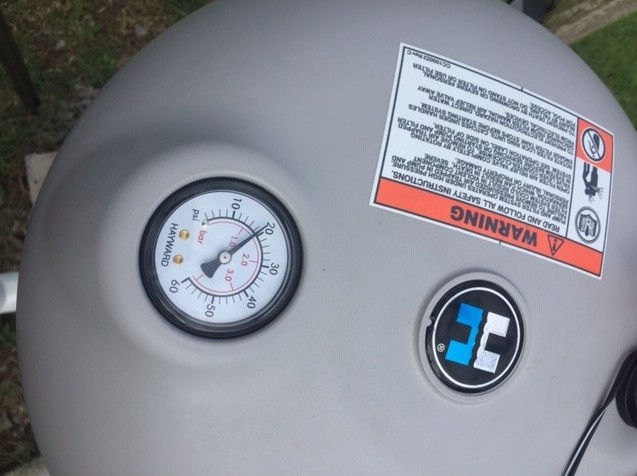
Hayward says the cartridge should be cleaned when the pressure rises 5–7 PSI above the clean or initial starting pressure.
That means the important number isn't a fixed PSI reading. It's how far the pressure has risen compared with your own filter's normal clean reading.
That is a much better maintenance trigger than saying:
Clean it every X days.
Every pool loads its filter differently.
Once the pressure reaches that point, shut the system down according to Hayward's instructions, relieve the pressure, open the Easy-Lok ring and remove the cartridge.
Hayward recommends cleaning the element from the top down using a suitable cartridge-cleaning wand or a garden hose with a high-pressure nozzle.
Because the CCX1500RE is a 150 sq ft cartridge, it's physically much larger than an Intex Type A or Type B filter.
That's one of the trade-offs.
You clean it less like a small disposable-style cartridge and more like a substantial piece of filtration equipment.
If you regularly clean cartridge media, our Aquatix Pro Pool Filter Cartridge Cleaner review looks at whether a dedicated six-jet cleaning head offers enough convenience over a normal hose nozzle to be worthwhile.
What About the “Filters Down to 10 Microns” Claim?
You may also see the XStream described as filtering particles down to 10 microns.
We wouldn't use that as one of our main reasons to buy the XStream.
Hayward's current XStream manual gives us the filter area, design flow, pressure rating, cartridge construction and replacement-cartridge information, but it doesn't state a 10-micron filtration rating in its product-performance specifications.
That doesn't mean a cartridge can't capture very fine material.
It means we don't need to turn a marketing graphic into an established technical specification when the current manufacturer manual doesn't support it.
More importantly, micron ratings alone don't tell you which filtration system will be easier or better to own.
For most above-ground pool owners, proper sizing, circulation, filter capacity and realistic maintenance matter much more.
The Easy-Lok Ring Is a Small Feature That Matters
The large black ring around the middle of the XStream isn't just part of the styling.

Hayward's Easy-Lok design allows the upper section of the filter to be released so you can reach the cartridge inside. The current manual describes it as providing quick access to internal components in a single turn.
That's useful because this is a filter you're going to open repeatedly over its lifetime.
We'd much rather have a straightforward access system than fight with multiple clamps every time the cartridge needs attention.
You still need to shut the pump down, relieve pressure and follow Hayward's opening procedure before removing the lid.
But once you're maintaining a cartridge this size, details like easy access become much more important than they might seem when you're first shopping.
Don't Overlook the 1.5-Inch Plumbing
This is one area we'd check before ordering.
The XStream uses 1.5-inch connections, and Hayward's manual is written around 1.5-inch flexible pipe or appropriate rigid plumbing.
If your existing above-ground pool is already set up with 1.5-inch fittings, that's straightforward.
There's another compatibility point we'd check before worrying about adapters.
Hayward specifies the XStream for permanently installed above-ground pools and says it should not be used with storable pools.
So if you have a seasonal soft-sided pool that's designed to be taken down and stored, we wouldn't treat the XStream as simply a larger replacement pump that can be made compatible with a few hose adapters.
For a permanently installed above-ground pool using smaller plumbing, adapters or changes to the existing connections may still be needed. Hayward's XStream filter itself uses 1.5-inch connections.
The 1.5 HP PowerFlo Matrix Pump Is Part of the Appeal — and the Cost
The current W3CC15093S isn't just a filter housing.
It comes with Hayward's 1.5 HP PowerFlo Matrix pump, model SP1593. Hayward's parts documentation confirms that pump as the 1.5 HP pairing for the XStream system.
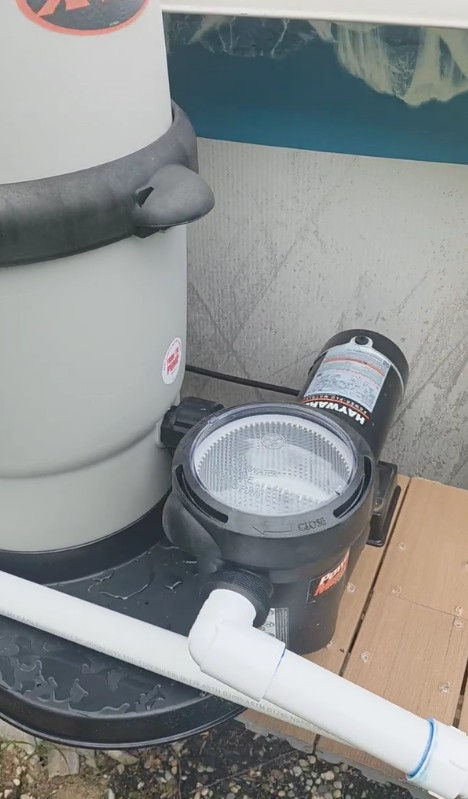
It's a single-speed above-ground pump with 1.5-inch connections.
One notable difference from the Intex C-series is that there isn't a built-in filtration timer on this pump. If automated scheduling matters to you, you'll need to account for that separately. Current PowerFlo Matrix specifications identify the W3SP1593 as non-programmable with no included timer.
That's something we'd expect buyers to know at this price.
The XStream gives you substantially more filtration hardware than an Intex cartridge pump, but it doesn't necessarily give you more convenience features.
Hayward XStream vs Intex C2500: Which Cartridge Pool Filter Makes More Sense?
These aren't really equal competitors.
The C2500 is the larger end of Intex's compact cartridge-pump range.
The XStream is a full-size Hayward cartridge pool filter system.
The C2500 gives you 1,900 GPH system flow, an automatic timer and a much smaller Type B cartridge.
It's considerably simpler.
Our Intex C2500 Cartridge Filter Pump review explains why we'd generally use it on typical round pools up to around 18 ft.
The XStream makes more sense when you want to stay with cartridge filtration but have outgrown that class of equipment.
So we wouldn't pay XStream money for an 18 ft pool simply because it's the more substantial system.
But for a larger above-ground pool, this is exactly why we wanted a high-capacity cartridge option in our filtration recommendations rather than telling everyone to switch automatically to sand.
Would We Choose the XStream or a Sand Filter?
This comes down much more to how you want to maintain your pool than to one filtration technology being universally better.
With the XStream:
you don't backwash,
you don't buy sand or other granular filter media,
and you can inspect the actual cartridge whenever you open the housing.
But when it gets dirty, you physically remove and wash a large cartridge.
With a sand filter, routine cleaning is usually easier because you turn the valve to backwash rather than opening the housing.
The trade-off is water used during backwashing, plus eventual filter-media maintenance.
For a larger above-ground pool, we'd be comfortable with either route.
If you specifically want cartridge filtration, the XStream is the option we prefer over trying to stretch a smaller C-series system too far.
If your priority is the easiest routine cleaning possible, we'd seriously compare it with a properly sized sand-filter system.
Is the XStream Worth Paying More For?
This is the part where we wouldn't dance around the price.
The XStream sits in a completely different price bracket from the Intex C1000, C1500 and C2500.
You're paying for:
a much larger filter body,
150 sq ft of cartridge media,
a separate 1.5 HP PowerFlo Matrix pump,
proper pressure monitoring,
serviceable components,
and a more substantial filtration setup overall.
If you own a smaller above-ground pool, you probably won't get enough benefit from all of that to justify the cost.
For a larger pool where you specifically want high-capacity cartridge filtration, the argument becomes much stronger.
The XStream isn't attractive because it's luxurious.
It's attractive because it fills a gap that the smaller cartridge systems don't.
Hayward XStream Pros and Cons
Pros
Large 150 sq ft cartridge gives you far more filter area than compact cartridge systems.
Current package includes a 1.5 HP PowerFlo Matrix pump.
Designed specifically for above-ground and on-ground pools.
Proper pressure gauge helps you clean based on filter condition rather than a fixed schedule.
Easy-Lok ring gives relatively straightforward access to the cartridge.
No backwashing or sand media required.
1.5-inch plumbing is well suited to a higher-capacity filtration setup.
Replacement CCX1500RE cartridge is clearly identified by Hayward.
Cons
Much more expensive than compact Intex cartridge systems.
Overkill for many small and medium above-ground pools.
The large cartridge still has to be physically removed and cleaned.
No built-in timer on the current 1.5 HP PowerFlo Matrix pump.
1.5-inch plumbing may mean adapters or changes if your pool currently uses smaller hoses.
We found conflicting 100 vs 120 GPM figures online, so buyers need to understand the difference between filter design flow and actual system flow.
Hayward's current warranty for the XStream filter system is one year.
Who Is This Hayward Cartridge Filter Best For?
We'd put the XStream high on the list for someone with a larger above-ground pool who wants to remain with cartridge filtration.
It's particularly interesting once you're past the size range where we'd comfortably recommend compact cartridge systems such as the C2500.
It also suits owners who like being able to physically remove and inspect the filter media rather than backwashing a sand filter.
The price makes much more sense when you're actually going to use the extra capacity.
For a 10, 12 or 15 ft pool, we wouldn't.
Who Should Skip It?
We'd skip the XStream if you're simply trying to improve filtration on a small pool.
There are much cheaper ways to do that.
We'd also think twice if your main frustration with cartridge filtration is having to remove and rinse cartridges.
The XStream gives you a much bigger cartridge; it doesn't eliminate cartridge cleaning.
If that job is exactly what you're trying to get away from, a sand filter may suit you better.
And if you're currently on small 1.25-inch hoses, check how much conversion work will be required before ordering. This is a heavier-duty system, not necessarily a drop-in replacement for every stock above-ground pool pump.
Our Verdict
The Hayward XStream is one of the strongest options we'd consider for an above-ground pool owner who wants high-capacity cartridge filtration rather than moving to sand.
The 150 sq ft CC1500 filter and 1.5 HP PowerFlo Matrix pump put it in a very different class from compact cartridge systems such as the C1000, C1500 and C2500.
That extra capacity comes with a much higher purchase price and a physically larger cartridge to maintain.
So this is not the filter we'd recommend simply because it's “better.”
It's the filter we'd recommend when the pool is large enough to justify it.
For an 18 ft pool, we'd normally start with the C2500.
Once we're into larger 21–27 ft territory and the owner wants to stay with cartridge filtration, the XStream becomes considerably easier to justify.
Our recommendation: A premium/high-capacity cartridge option for larger above-ground pools. Excellent fit for the right setup; unnecessary expense for smaller ones.
Related Filtration Guides
👉Still comparing cartridge systems? See our Best Cartridge Filters for Above-Ground Pools to compare the options we'd choose for small, medium and larger above-ground pools.
👉 For a more compact cartridge system, see our Intex C2500 Cartridge Filter Pump review.
👉 If you're cleaning cartridge filters regularly, see our Aquatix Pro Pool Filter Cartridge Cleaner review.
👉 For more filtration options and maintenance advice, visit our Filtration & Pumps section.
Frequently Asked Questions
Is the Hayward XStream made for above-ground pools?
Yes. Hayward identifies the XStream as an above-ground/on-ground pool filtration system. The current W3CC15093S package combines the 150 sq ft CC1500 cartridge filter with a 1.5 HP PowerFlo Matrix pump.
What size pool is the Hayward XStream best for?
We see the XStream as a high-capacity option for larger above-ground pools, particularly around the 21–27 ft round range or similar water volumes. That isn't a manufacturer maximum; actual gallons, plumbing and pool configuration still matter.
Does the Hayward XStream have a 100 or 120 GPM flow rate?
Hayward's current XStream manual lists the CC1500 design flow at 100 GPM. Some retailer specifications quote 120 GPM. We'd use Hayward's current manual, while remembering that design flow is a filter rating rather than guaranteed installed system flow.
Is 100 GPM the actual flow through my pool?
Not necessarily. The 100 GPM figure is the CC1500 filter's design-flow rating. Actual installed flow depends on the pump, plumbing, fittings, cartridge condition and system resistance.
What replacement cartridge does the Hayward XStream CC1500 use?
The 150 sq ft XStream CC1500 uses Hayward replacement cartridge CCX1500RE.
When should I clean the Hayward XStream cartridge?
Hayward recommends cleaning the cartridge when filter pressure rises 5–7 PSI above the clean or initial starting pressure.
Does the Hayward XStream filter down to 10 microns?
You may see 10-micron filtration quoted in promotional material, but Hayward's current XStream manual doesn't state a 10-micron rating in its performance specifications. We therefore wouldn't use that claim as the main reason to choose the system.
Does the Hayward XStream have a built-in timer?
The current W3CC15093S system uses a single-speed 1.5 HP PowerFlo Matrix pump. A built-in timer is not included with that pump, so automated scheduling needs to be handled separately if required.
Is the Hayward XStream better than the Intex C2500?
They suit different pools. We'd generally use the C2500 for typical above-ground pools up to around 18 ft, while the XStream becomes more attractive for larger pools where you want substantially more cartridge-filter capacity.


Comments